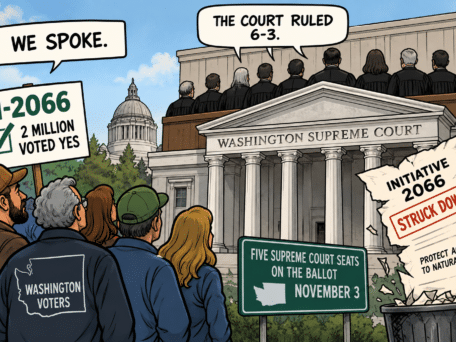
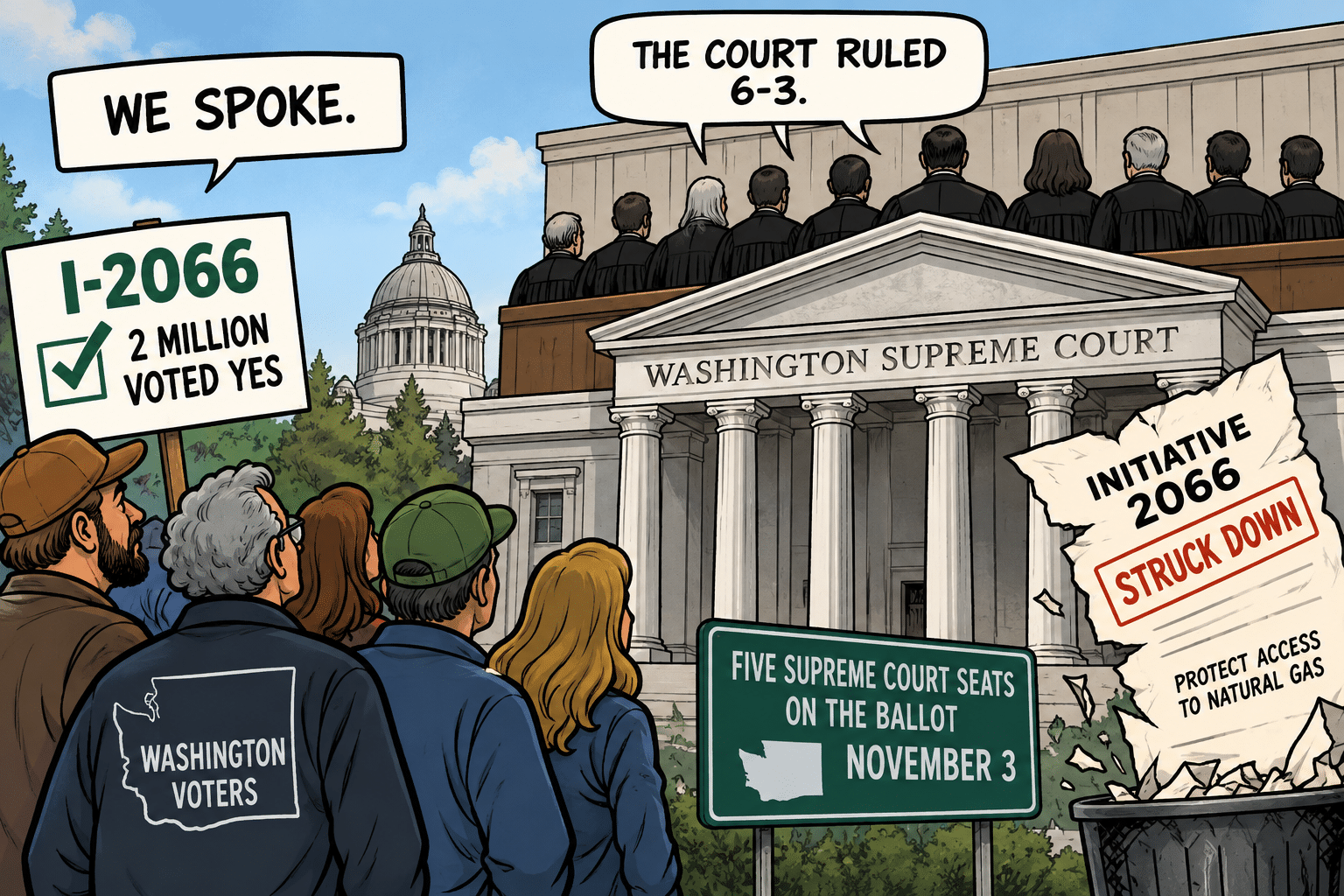
The ruling against Initiative 2066 puts the power of Washington’s highest court in sharp focus just weeks before five of its nine seats appear on the ballot.
Nearly 2 million Washingtonians voted to approve Initiative 2066 in 2024, backing a measure intended to protect access to natural gas.
Now, the law is gone.
In a 6–3 decision, the Washington Supreme Court struck down I-2066, ruling that it violated the state Constitution’s single-subject requirement. The majority found that the initiative combined multiple subjects and invalidated the entire measure. Three justices disagreed.
approved law is not exempt from the Constitution. But the ruling makes one thing crystal clear: The decisions made by Washington’s nine Supreme Court justices can have enormous consequences, even after nearly 2 million people have cast their votes.
And with five Supreme Court seats on the November ballot, the timing is hard to ignore.
Five Supreme Court seats. One consequential election.
On November 3, voters will choose justices for five of the court’s nine seats. That is more than half the court appearing on the ballot in a single election.
State Supreme Court races receive less attention than contests for Congress or the state Legislature. Yet Supreme Court justices rule on some of Washington’s biggest legal disputes, from taxes and election laws to the limits of government power. The court is also expected to face litigation over the state’s new income tax.
The I-2066 decision shows why judicial philosophy matters. The majority concluded that the initiative covered four distinct subjects that lacked the necessary constitutional connection. The dissent disagreed with the majority’s application of the single-subject rule. Those competing interpretations produced very different answers to the same question: Could the law voters approved remain in effect?
More legal fights are on the horizon
The natural gas ruling comes as Washington prepares to vote on additional statewide initiatives, including Initiative 645, which seeks to repeal the state’s new income tax.
The outcome of a ballot measure and its legal fate are separate questions. A measure can win at the polls and still face a constitutional challenge, just as I-2066 did. Whether any future challenge succeeds will depend on the measure and the legal arguments presented—not simply on how the court ruled in this case.
For voters trying to understand the November judicial races, the I-2066 decision offers something more useful than campaign slogans: an actual ruling to examine, including the majority’s reasoning and the dissent’s objections.
Nearly 2 million Washingtonians approved I-2066. Six justices concluded that it violated the Constitution. Three disagreed.
With five Supreme Court seats on the ballot, the ruling makes the court’s power—and the legal questions at stake in its elections—impossible to overlook.
A closer look at the judicial candidates
Five candidates in Washington’s nonpartisan Supreme Court races have received recommendations from the Washington State Republican Party: Scott Edwards, Judge David Stevens, Judge Sean O’Donnell, Judge Dave Larson and Todd Bloom. The Skagit County Republican Party also lists all five among its general-election recommendations.
Their support extends beyond party organizations. Edwards has a reported endorsement from the NFIB Small Business PAC; Larson has support from Family Policy Institute Washington Action; and O’Donnell has endorsements from the Washington Farm Bureau, Washington Council of Police and Sheriffs, Washington Retail Association and several prominent Democrats.
With five Supreme Court seats on the November ballot, the I-2066 ruling offers a timely reason to examine these candidates’ backgrounds, endorsements and approaches to interpreting Washington’s Constitution.