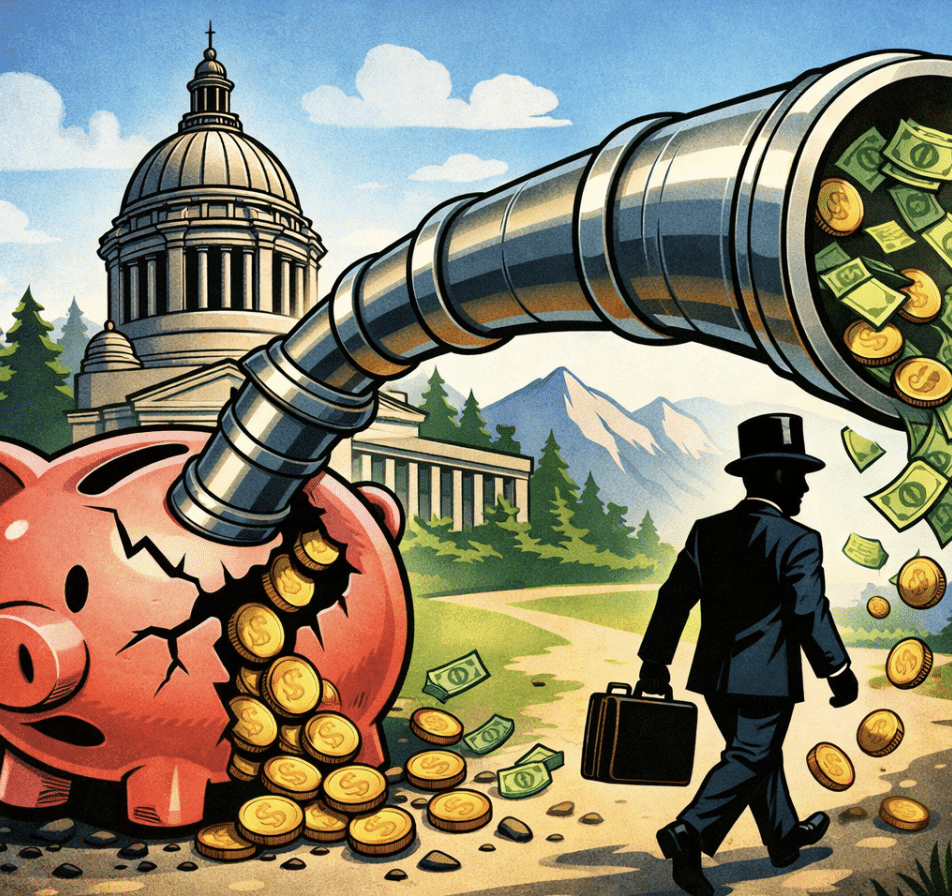
Washington Democrats spent years insisting they weren’t trying to pass an income tax. Then they did it anyway—and now they’re acting surprised it might be unconstitutional.
Welcome to the latest Olympia special: pass first, lawyer up later.
During the 2026 legislative session, Democrats rammed through a 9.9% tax on income over $1 million—branding it, of course, as a “targeted” tax on the wealthy. Because nothing says “trust us” like politicians promising a tax will definitely stay limited forever.
But here’s the problem they can’t spin away: Washington’s constitution doesn’t care what you call it.
The Part Democrats Keep Hoping You Won’t Read
Washington’s constitution is pretty clear on taxes. Article VII requires that property taxes be uniform and capped at 1%. And for more than 90 years, the courts have said one very inconvenient thing for Democrats:
Income is property.
That’s not a talking point—that’s settled law going back to the Culliton v. Chase decision in 1933. The Washington State Supreme Court didn’t hedge. It didn’t leave wiggle room. It said income taxes are property taxes, and therefore must follow those strict constitutional rules.
So let’s connect the dots:
- Democrats passed a graduated income tax (9.9% over $1M)
- The constitution requires uniform taxation
- The constitution caps property taxes at 1%
You don’t need a law degree to see the problem.
So Naturally… They Passed It Anyway
Gov. Bob Ferguson signed the bill with a celebratory “we did it,” as if decades of constitutional precedent were just a minor technicality.
Democrats argue this time is different. They claim the tax is structured in a way that might survive court scrutiny. Translation: they’re hoping the court changes its mind.
That’s the entire strategy.
The Lawsuit Was Inevitable
Within days, a legal challenge was lined up. The Citizen Action Defense Fund, with former Attorney General Rob McKenna leading the charge, is preparing to argue exactly what everyone already knows:
This tax violates the constitution. Full stop.
Their argument is brutally simple:
- If income is property (it is, per the court),
- Then this tax is a property tax,
- And it clearly violates both uniformity and the 1% cap.
Game over—at least under current law.
The Real Goal: Force the Court to Blink
Let’s be honest about what’s happening.
This isn’t just about raising revenue. If Democrats wanted money, they could cut spending or reprioritize the massive budget they already have. Instead, they chose a legally shaky income tax because they’re trying to do something much bigger:
They want the court to overturn its own precedent.
They couldn’t get a constitutional amendment (because voters would likely reject it), so now they’re taking the long shot—pass an unconstitutional law and dare the courts to stop them.
It’s not bold. It’s a gamble.
Meanwhile, the Fallout Is Already Starting
Even before the courts weigh in, the damage is underway:
- Companies and high earners are moving out of state, with even Starbucks shifting leadership and operations toward places like Nashville
- Business leaders are warning about capital flight
- More employers are quietly relocating jobs out of Washington altogether
And if you think that’s unrelated, you haven’t been paying attention.
The Part They Really Don’t Want You Thinking About
Let’s say, for a moment, Democrats actually win in court.
Let’s say the Washington State Supreme Court suddenly decides income isn’t property anymore—or finds some workaround.
What happens next?
Do you really think this tax stays neatly boxed around “millionaires”?
Of course not.
Once the legal barrier is gone, it’s just a matter of time before lawmakers start lowering the threshold. First it’s $1 million. Then $500,000. Then $250,000. And eventually… everyone.
Because once you’ve established the power to tax income, expanding it isn’t a legal question anymore—it’s a political one.
The Bottom Line
Washington Democrats finally got their long-coveted income tax.
Now they get to explain to a judge why 90 years of constitutional law shouldn’t apply anymore.
And if they somehow win, it won’t be the end of the story—it’ll be the beginning of a much broader income tax that doesn’t stop at millionaires.