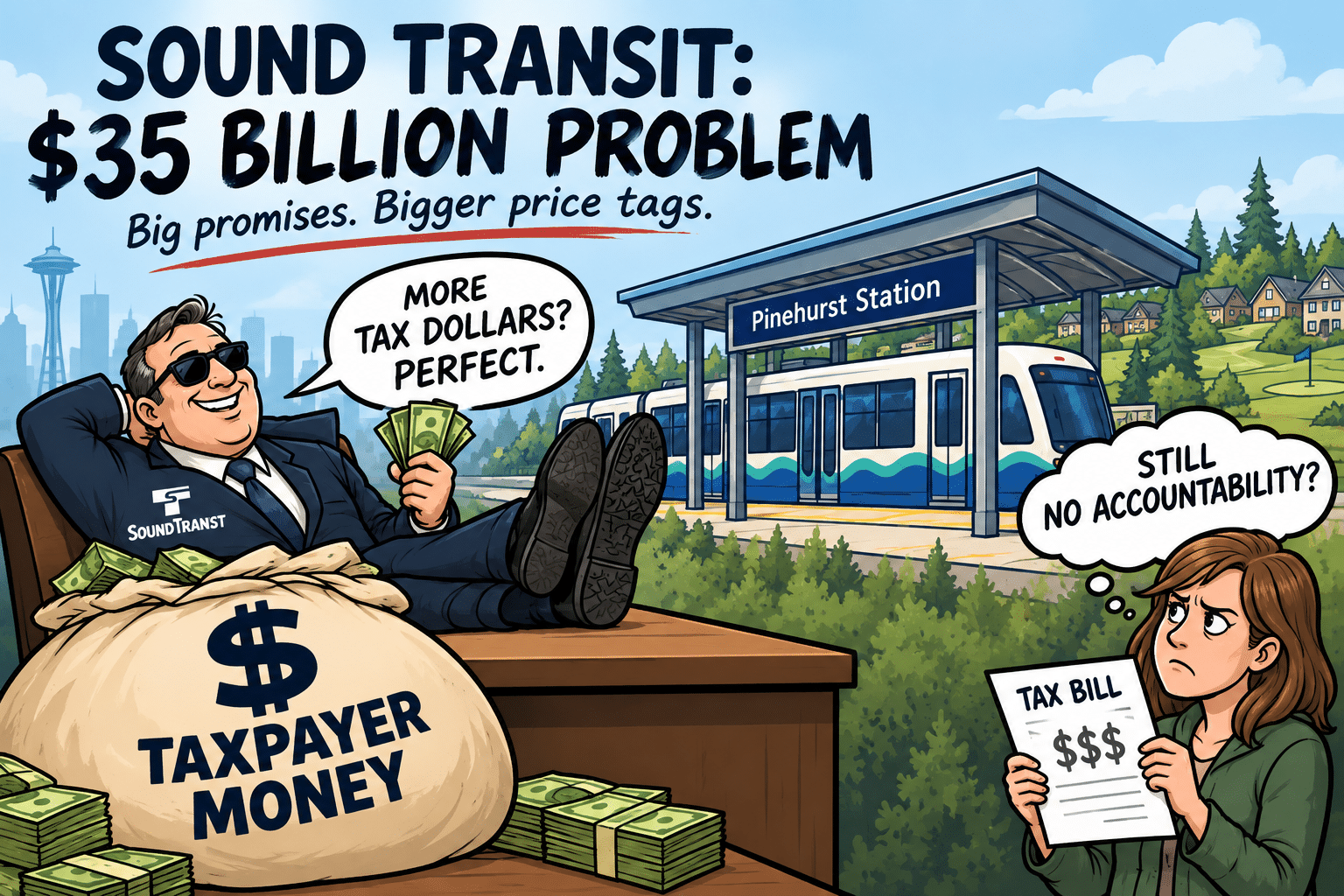
If Sound Transit were a private company, its financial track record would be cause for serious concern. But because it has access to a seemingly endless stream of taxpayer dollars, the agency can blow through billions, push projects further into the future, and call it a “financial challenge.”
The latest numbers are staggering.
Sound Transit’s own 2026 financial plan estimates it needs $34.5 billion in additional cost savings or new funding to fully deliver the ST3 program on its existing schedule. The agency says system expansion costs have increased by roughly $27 billion, while service-delivery pressures have added another $5 billion.
That’s not a little budget hiccup.
That’s a $34.5 billion problem for an agency that already collects taxes and fees from residents across the region.
And what are taxpayers getting for all that money?
More delays.
The ST3 plan approved by voters in 2016 was originally projected to cost about $54 billion and be completed by 2041. The timeline has now slipped to roughly 2052, while major projects have been delayed, reduced or pushed into the distant future.
The Ballard extension has been delayed. West Seattle has been delayed. Tacoma is delayed. Everett is delayed. The Kirkland-Issaquah line has been pushed to 2050.
And Sound Transit has had to reconsider whether it can actually afford everything voters were promised.
Yet somehow, there was still $240 million for Pinehurst.
$240 Million for a Station Nobody Can Explain
Pinehurst opened this week as Sound Transit’s first infill station.
The agency says it will eventually serve roughly 3,400 riders a day, with its project page putting the expected range at 2,600 to 4,200 daily boardings.
But the station was built in a North Seattle neighborhood where the surrounding development that was supposed to help generate riders has been delayed.
The price tag is also difficult to ignore: regional planning documents now put the project at nearly $248.5 million.
Former Sound Transit Board member David Baker called it a “$240 million boondoggle” and said there was no need for the station.
And here’s the kicker: while Sound Transit is struggling to fund major projects that would actually expand the system, it has managed to deliver a quarter-billion-dollar station in the middle of an existing rail corridor.
This is what happens when an agency has money to spend but apparently very little incentive to ask whether every expenditure is worthwhile.
The Price Keeps Going Up
Sound Transit’s problems aren’t limited to Pinehurst.
Take East Link. The Federal Highway Administration puts the cost of the East Link Extension and associated I-90 transit work at more than $4 billion.
Then there’s West Seattle Link.
Sound Transit has acknowledged that the project’s estimated cost had reached $7.1 billion to $7.9 billion, before the agency began looking at changes that could potentially save about $2 billion.
Notice the pattern?
The agency announces enormous projects. Costs climb. Timelines slip. Then officials return to the drawing board looking for ways to make the numbers work.
And taxpayers are expected to simply keep paying.
Accountability Apparently Comes Later
Sound Transit now says it needs to improve accountability.
In its 2026 system plan, the agency announced plans for an “adaptive program management plan” and a project delivery framework intended to provide more disciplined oversight, identify cost savings and give the board greater visibility into project risks and contingencies.
That’s great.
But taxpayers could be forgiven for asking: Why wasn’t this standard operating procedure before the agency found itself $34.5 billion short?
You shouldn’t need a $35 billion financial hole to discover that projects need cost controls.
You shouldn’t need decades of delays to realize that schedules matter.
And you shouldn’t need a quarter-billion-dollar station to learn that taxpayers might want someone asking whether a project is actually necessary before the money is spent.
Sound Transit says it remains committed to delivering the projects voters approved.
But the agency’s own numbers show just how far reality has drifted from the promises voters were given.
The projects cost more. They take longer. Some have been reduced. Others have been delayed until the 2040s and 2050s.
Meanwhile, the tax bills keep coming.
Someone Has to Be Accountable
This isn’t an argument against public transportation. It’s an argument for basic fiscal accountability.
If an agency asks voters to approve billions of dollars in taxes and fees based on a specific plan, there should be consequences when that plan blows through its budget by tens of billions.
Instead, Sound Transit has developed a system where the solution to overspending appears to be finding additional revenue, delaying projects and looking for “cost savings” after the fact.
That isn’t accountability.
That’s an open-ended taxpayer credit card.
And until someone is actually held responsible when Sound Transit blows through another billion dollars, there is little reason to believe the agency’s spending habits will change.
For an agency staring at a $34.5 billion affordability gap, perhaps the first question shouldn’t be, “How do we find more money?”
It should be:
“How did we spend this much money and still not have enough?”