For years, Democrats in Olympia insisted their redistricting overhaul was about “fairness” and “representation.” But now, thanks to a major shift from the U.S. Supreme Court, the very foundation of that argument is starting to crack.
And not quietly.
The Court’s recent ruling in the Louisiana case (Alexander v. South Carolina State Conference of the NAACP and related redistricting decisions tightening race-based mapmaking standards) made one thing clear: states can’t use race as the dominant factor when drawing political maps—even when they claim it’s to comply with the Voting Rights Act.
That’s a problem for Washington.
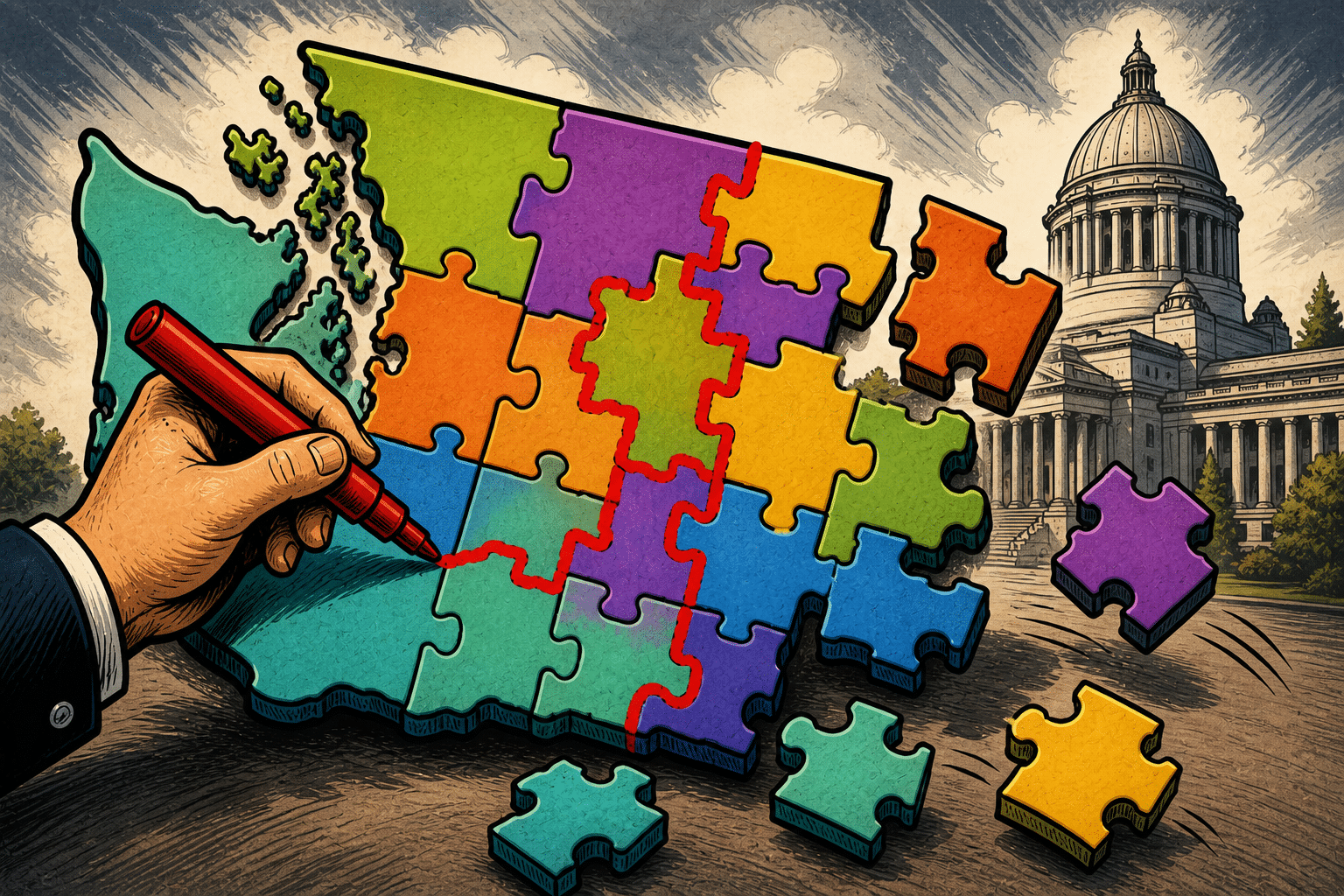
Because here, the Yakima Valley redraw came out of Soto Palmer v. Hobbs, where a federal court ordered new legislative maps after ruling the previous ones diluted Latino voting power. The “fix” was a newly engineered district designed to create a Latino majority.
But that redraw didn’t just tweak lines—it stretched communities across counties, adjusted election timing, and ultimately shoved GOP State Senator Nikki Torres out of her own district.
Yes—ironically, in the name of boosting minority representation, Democrats managed to push out a Latina Republican.
You can’t make this stuff up.
Now comes the awkward question:
Was this really about fair representation—or about hitting a political outcome?
Because under the Supreme Court’s updated standard, that distinction suddenly matters a lot more.
To be clear, Washington’s current maps aren’t disappearing tomorrow. They were imposed by a federal court after the Soto Palmer ruling, and courts don’t love reopening these fights unless they absolutely have to.
But here’s the catch: the legal logic used to justify those maps just got a whole lot shakier.
Anyone looking to challenge them now has a new argument—one that didn’t exist before. If race can’t be the driving force behind redistricting, then maps built primarily around racial targets start to look a lot more vulnerable.
And that’s where things get interesting.
Because what Democrats sold as a necessary correction may end up looking like an overcorrection—one that prioritized political outcomes over consistent legal standards. The same people who argued these maps were essential to fairness may soon have to defend whether they crossed the very line the Supreme Court just reinforced.
Meanwhile, Washington is left with a system that:
- Wasn’t finalized by the legislature
- Wasn’t decided by the state Supreme Court
- And instead came out of a federal courtroom
Now, with the rules changing, the question isn’t whether this debate is over.
It’s whether it’s about to start all over again.
Because when you build political maps around shifting legal theories, you shouldn’t be surprised when the ground moves.
And in Olympia, it just did.